
As Pakistan steps into an era of advanced telecommunications following recent spectrum auctions and infrastructural updates, the conversation naturally pivots from network towers to the devices in people’s hands. Entering the next phase of digital maturity requires looking closely at how 5G smartphones are manufactured, priced, and adopted across the country.
The Local Manufacturing Landscape
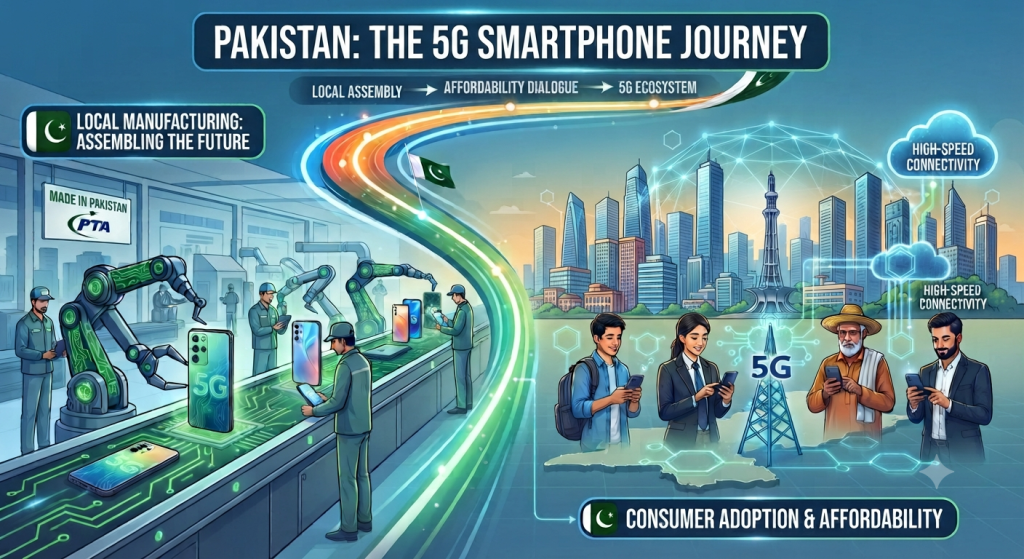
Local assembly has long been a cornerstone of Pakistan’s mobile strategy, successfully reducing reliance on fully imported units. Data compiled by the Pakistan Telecommunication Authority (PTA) highlights significant movement in local production lines, with nearly a million 5G-capable smartphones assembled domestically.
Key industry players have spearheaded this assembly phase through local partnerships:
- Samsung: Assembled locally via Lucky Motor Corporation, capturing a major share of domestic production.
- Vivo: Manufactured through Coastal Jade Technology, contributing heavily to mid-range availability.
- Infinix / Tecno: Produced in collaboration with Inovi Telecom, catering directly to value-conscious consumers looking for future-proof connectivity.
Despite these milestones, local production lines face balancing acts. Integrating next-generation modems and radio components typically increases manufacturing costs compared to legacy 4G units. Consequently, local manufacturing outputs have historically leaned toward budget-friendly 4G entry-level devices, making the scaling of affordable domestic 5G units an ongoing industry priority.
Affordability and the Consumer Dilemma
While network trials showcase impressive multi-gigabit speeds, a technical bottleneck remains: device accessibility. For an average consumer, high-end mobile taxation and upfront retail costs can turn purchasing a 5G-enabled handset into a major financial consideration.
To counter this, telecom operators, industry stakeholders, and government bodies have engaged in continuous policy dialogues regarding handset financing frameworks. Proposals centered around buying smartphones on manageable installments aim to protect students, remote workers, and middle-class households from bearing the full brunt of upfront retail pricing. Ensuring that next-generation connectivity is not restricted exclusively to luxury or high-income brackets is essential for widespread digital inclusion.
What to Look for in a 5G Smartphone
Consumers currently navigating the Pakistani market for a 5G-ready device evaluate several core hardware criteria:
- Processor & Modem Efficiency: Modern chipsets (such as advanced MediaTek Dimensity and Qualcomm Snapdragon series) integrate power-efficient 5G modems that prevent excessive battery drain during data-heavy tasks.
- Supported Band Compatibility: Ensuring that a handset supports the specific sub-6GHz bands rolled out by local operators guarantees stable network locking.
- Future-Proofing Storage and RAM: With data speeds scaling rapidly, standard configurations of 8GB RAM and ample storage are becoming the baseline for multitasking and cloud-integrated applications.
The Road Ahead
The transition to 5G in Pakistan is a multi-step journey. While spectrum deployment lays the structural groundwork, true digital transformation depends on aligning device affordability with consumer purchasing power. As regulatory bodies refine financing policies and local assembly ecosystems adapt to tighter component requirements, the local market is steadily marching toward a future where high-speed mobile connectivity is a standard utility rather than an exclusive luxury.
Pakistan’s 5G Smartphone Plan Hits Delay | Dawn News English
This video provides additional context regarding the policy hurdles and government discussions surrounding the rollout and financing of 5G handsets in Pakistan.
Leave a thought 🤔 (0)
Be the first viewer to leave a thought!