
The term “Mango People” is a humorous, literal translation of the Urdu phrase “Aam Aadmi” (عام آدمی), which means “common man.” In Pakistan—and across the broader South Asian region—this phrase is deeply ingrained in social and political discourse. Its evolution into “Mango People” is a result of a linguistic coincidence that has been repurposed as a cultural metaphor.
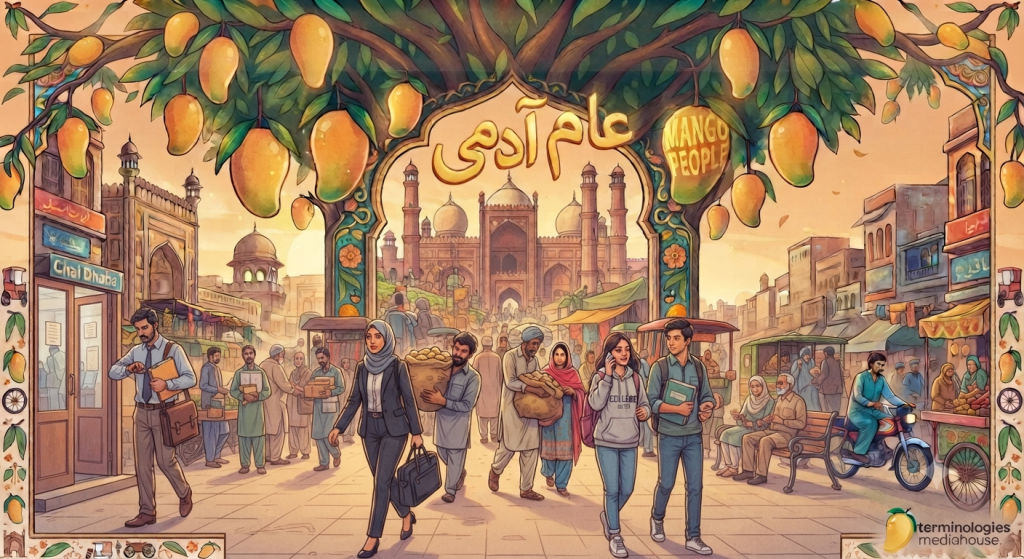
The Linguistic Coincidence
The term exists because the word aam has two completely different origins and meanings in the region:
• Aam (عام) – “Common”: This is a loanword from Arabic/Persian, meaning ordinary, general, or public. It is the word used in Aam Aadmi to denote the everyday citizen.
Because these two words are spelled and pronounced identically in Urdu, English-speaking residents and social media users began jokingly referring to the Aam Aadmi as the “Mango People.” It was initially a linguistic pun, but it quickly gained traction as a witty way to describe the populace.
A Cultural Metaphor
Beyond the pun, the term resonates because it serves as an effective metaphor for the average Pakistani citizen:
• Ubiquity: Just as the mango is known as the “King of Fruits” in Pakistan and is found in almost every household during the summer, the “common man” is seen as the vital, essential backbone of the country.
• Diversity and Resilience: People often use the comparison to describe the nature of the citizenry—some are “sweet” or “ripe” with wisdom, while others are “tough-skinned” or “bruised” by the daily hardships of life. It reflects the idea that common people are messy, real, and hardworking, yet ultimately provide the “flavor” and character of the nation.
• Accessibility: Much like the mango, which is a staple that bridges the gap between different social classes, the concept of the Aam Aadmi is meant to represent the shared experience of the masses, regardless of their background.
• Universality: Like the mango, which is loved across all social classes—from the bustling markets of Multan to the high-rises of Islamabad—the “Mango People” represent the vast majority of the population. They are the essential, everyday citizens who keep the country running.
• The “Rough and Ready” Spirit: Just as the mango is a fruit that is meant to be enjoyed without pretense—often in the heat of summer, with hands getting sticky and juices flowing—the “Mango Person” is often viewed as someone who is “real,” unfiltered, and hardworking. They navigate the daily grind with a blend of patience, humor, and grit.
The “Mango People” in Modern Pakistan
In the context of modern Pakistan, being a “Mango Person” is about more than just economics or social standing. It is about the shared experience of the national identity:
• The Seasonal Bond: It’s the shared anticipation of the first Chaunsa of the season, the debates over whether Sindhri or Anwar Ratol is superior, and the simple joy of sharing a crate with neighbors.
• Civic Resilience: It’s about the people who show up to work, manage households through inflation, and maintain their social ties despite the pressures of a rapidly changing world.
Political and Satirical Reclaiming
The term’s popularity in public discourse was cemented by its use in politics and satire:
• Political Framing: In Pakistan and neighboring countries, politicians often invoke the Aam Aadmi to signal that their policies are for the benefit of the average citizen rather than the elite.
• Reclaiming the Narrative: The phrase “Mango People” gained a life of its own in the digital age. When members of the elite have occasionally used the term condescendingly or mockingly, the public has historically reclaimed it. By identifying as “Mango People,” citizens have turned a potential insult into a badge of honor—a symbol of the quiet, patient, and persistent strength of the people who keep the country running despite economic or social challenges.
Leave a thought 🤔 (0)
Be the first viewer to leave a thought!