
Harnessing the Sun; Why Solar Panels are Essential for the Future of Pakistani Cities. Urban landscapes across Pakistan are undergoing a quiet yet profound transformation. From the bustling commercial markets of Lahore and Karachi to the residential rooftops of Islamabad and Peshawar, a familiar sight is taking over: gleaming rows of photovoltaic solar panels. This rapid adoption is not merely a passing trend or an eco-friendly luxury; rather, it has become an absolute economic and infrastructural necessity for Pakistani cities.
As urban centers grapple with mounting systemic challenges, rooftop solar energy is emerging as a lifeline for households, small business owners, and municipal planners alike.
Crushing Electricity Tariffs
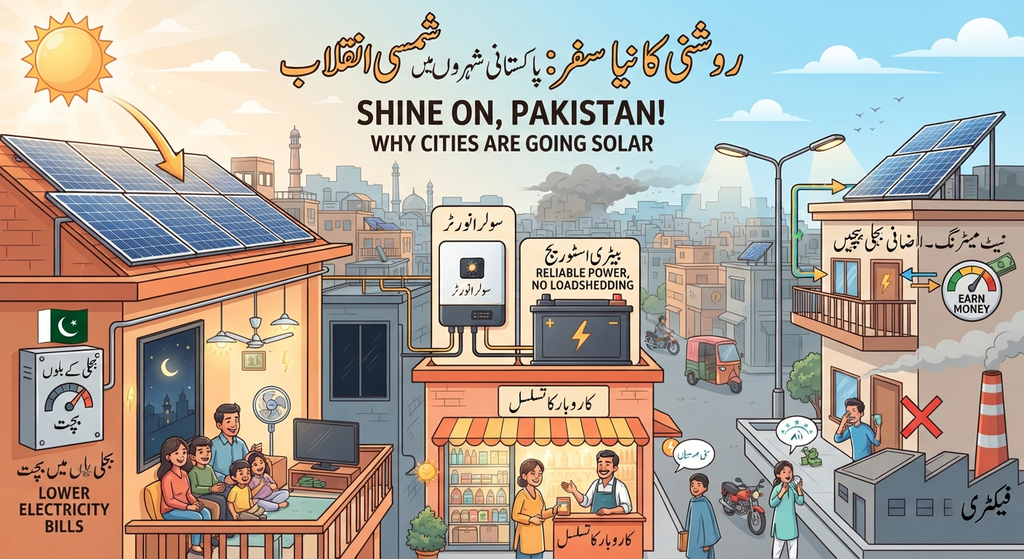
For the average city dweller, the arrival of the monthly utility bill has turned into a source of severe anxiety. Over the past few years, electricity tariffs in Pakistan have escalated at an unprecedented pace, driven by currency devaluation, structural economic reforms, and rising fuel adjustment charges. For urban households on fixed incomes, these inflated bills consume a staggering share of monthly budgets, forcing difficult trade-offs between energy use and necessities.
In this climate, solar panels offer a powerful path toward financial relief. Although the initial capital investment for procurement and installation can feel daunting, the math of long-term savings is undeniable. By generating their own electricity during peak daylight hours, urban homes and commercial enterprises can slash their grid electricity consumption by more than half, and in many cases, wipe out their bills almost entirely. With typical return-on-investment periods shrinking due to high utility rates, solar systems have transitioned from an experimental alternative to a sound financial asset.
Defeating Load-Shedding
Urban infrastructure in Pakistan has long struggled to keep pace with soaring power demands. Despite continuous capacity additions, the national grid frequently buckles under pressure, resulting in recurring bouts of scheduled load-shedding and agonizing unannounced power outages. Furthermore, voltage fluctuations can damage sensitive home appliances and halt industrial machinery. For Pakistani cities, solar power serves as a vital shield against grid unreliability. When integrated with modern hybrid inverters and efficient battery storage solutions, rooftop solar installations insulate households and offices from the chaos of grid failures. This localized energy resilience ensures that children can study uninterrupted, remote workers can maintain productivity, and small businesses can keep their doors open without relying on expensive, noisy, and polluting diesel generators.
Relieving Pressure on National Grids
Cities are massive energy sinks, drawing disproportionate amounts of power to fuel commercial centers, residential cooling needs, and public transport networks. During scorching summer months, air conditioning loads push national power grids to their absolute breaking points, triggering widespread system trips. Distributed rooftop solar acts as an effective decentralizing force. By meeting a substantial portion of urban daytime electricity demand locally, rooftop systems absorb peak loads that would otherwise overwhelm local transformers and transmission lines. Furthermore, local generation dramatically minimizes technical transmission and distribution losses—power that is traditionally lost as heat while traveling hundreds of kilometers from remote power plants to urban centers.
Business Resilience and Economic Vitality
Small and medium-sized enterprises (SMEs) form the backbone of Pakistan’s urban economy. From textile workshops and printing presses to retail stores and IT offices, businesses require stable, affordable power to survive and compete. When grid electricity is erratic or prohibitively expensive, operational margins shrink, forcing businesses to pass costs onto consumers or shutter operations altogether. Solar energy provides SMEs with predictable overhead costs. By locking in free fuel from the sun, business owners can protect their profit margins, maintain consistent production schedules, and retain their competitive edge, thereby safeguarding urban employment and economic dynamism.
Breathing Easier
Beyond the immediate financial and operational advantages, solar energy holds a crucial environmental mandate for Pakistani cities. Urban centers—particularly across the Punjab province—frequently rank among the most polluted in the world, plagued by hazardous winter smog, particulate matter, and vehicular emissions. Historically, widespread power outages forced commercial and residential sectors to rely heavily on backup diesel and petrol generators, compounding urban air pollution. Transitioning to clean, renewable solar power directly displaces fossil-fuel-generated electricity, cutting down carbon footprints and curbing local air pollutants. Cleaner air directly translates to better public health outcomes, reducing respiratory illnesses and lowering healthcare burdens on urban populations.
Looking Ahead
The sun-drenched climate of Pakistan presents a natural comparative advantage that the country is only beginning to tap fully. For Pakistani cities, solar panels are much more than a technological fix to a temporary energy crisis; they represent a fundamental paradigm shift toward energy democratization and resilience. As regulatory frameworks mature, net-metering expands, and financing options become more accessible, solar energy will continue to redefine the urban landscape. By turning every rooftop into a miniature power station, Pakistani cities are paving the way toward a cleaner, cheaper, and infinitely more self-reliant energy future.
Preferred System Specifications:
For a typical 7 Marla double-story home in Pakistan (roughly 1,900–2,200 sq. ft. constructed area), energy requirements usually range between 6 kW and 10 kW. The exact size depends on whether you run 1, 2, or 3 inverter Air Conditioners during summer. Net metering (green meter) allows you to export surplus power back to the grid during the day and offset nighttime grid consumption. Ensure your vendor handles the DISCO (LESCO, IESCO, K-Electric, etc.) approval process.
Batteries, Inverter and Panels
If installing a hybrid system for load-shedding backup, use Lithium Iron Phosphate (LiFePO4) batteries. They last 8–10 years, charge faster, and handle deep discharges far better than tubular batteries. Avoid installing a 10 kW inverter if you only have space or budget for 6 kW of panels, unless you plan to add panels within 6–12 months. Inverters run inefficiently when under-panelled. Insist on Tier-1 N-Type panels (Jinko, Longi, JA Solar, or Canadian). They perform significantly better in high Pakistani summer heat compared to older P-type panels. A single shadow from a water tank, dish antenna, or neighboring parapet wall can drop the performance of an entire string of panels. Map shadows at 9 AM, 12 PM, and 4 PM before finalizing placement. Avoid unbranded, non-flash-tested, or grey-market panels lacking a valid manufacturer warranty and serial number verification.
Washing panels during peak sun hours (11 AM – 3 PM) can shock and crack the glass due to extreme thermal contraction. Always wash panels early in the morning or after sunset.
Specifications for a 7 Marla House
| Component | Standard Setup (1-2 Inverter ACs) | Heavy Load Setup (2-3 ACs + Motor) |
|---|---|---|
| System Capacity | 6 kW – 8 kW | 10 kW |
| Monthly Bill Units | 600 – 900 units | 1,000 – 1,400 units |
| Average Daily Yield | 24 – 32 units/day | 40 – 45 units/day |
| Solar Panels | 10 – 14 panels (580W–600W N-type Tier-1) | 16 – 18 panels (580W–600W N-type Tier-1) |
| Inverter | 6 kW or 8 kW Hybrid / On-Grid (IP65) | 10 kW Hybrid / On-Grid (IP65) |
| Rooftop Space Needed | ~400–550 sq. ft. shade-free | ~650–750 sq. ft. shade-free |
| Structure Type | Raised structure (14-gauge L3/L2 galvanized steel) | Custom elevated frame (if rooftop space is tight) |
| Battery (Optional) | 5.1 kWh to 10 kWh Lithium-ion (LiFePO4) | 10 kWh to 15 kWh Lithium-ion (LiFePO4) |
Best Practices
- DO Elevate the Frame (L3/Custom Frame): On a 7 Marla roof, space gets tight with water tanks, stairs, and clotheslines. Installing elevated framing allows you to retain usable roof space underneath while ensuring zero shadow overlap.
- DO Ensure Proper Earth/Grounding & Surge Protection: Install a dedicated copper grounding rod (earthing pit) along with SPDs (Surge Protection Devices) and AC/DC breakers to protect against lightning spikes and DISCO voltage fluctuations.
- DO Use Pure Copper DC Cables: Demand 6mm² or 10mm² XLPE/PVC double-insulated pure copper wires (e.g., Pakistan Cables or Fast Cables) for panel-to-inverter runs to minimize power loss.
Critical Pitfalls
- DON’T Let Installers Drill Directly into the Roof Slab Without Waterproofing: Anchor bolts must be chemically sealed (using epoxy/Sika) and concrete pad blocks (paddis) should be poured above roof level to prevent long-term water seepage into the top floor bedrooms.
- DON’T Cheap Out on Distribution Boxes (DB): Avoid flimsy PVC distribution boxes or sub-standard breakers (like unbranded Chinese breakers). Use branded breakers (Schneider, ABB, or Chint) rated correctly for DC voltage.
Leave a thought 🤔 (0)
Be the first viewer to leave a thought!