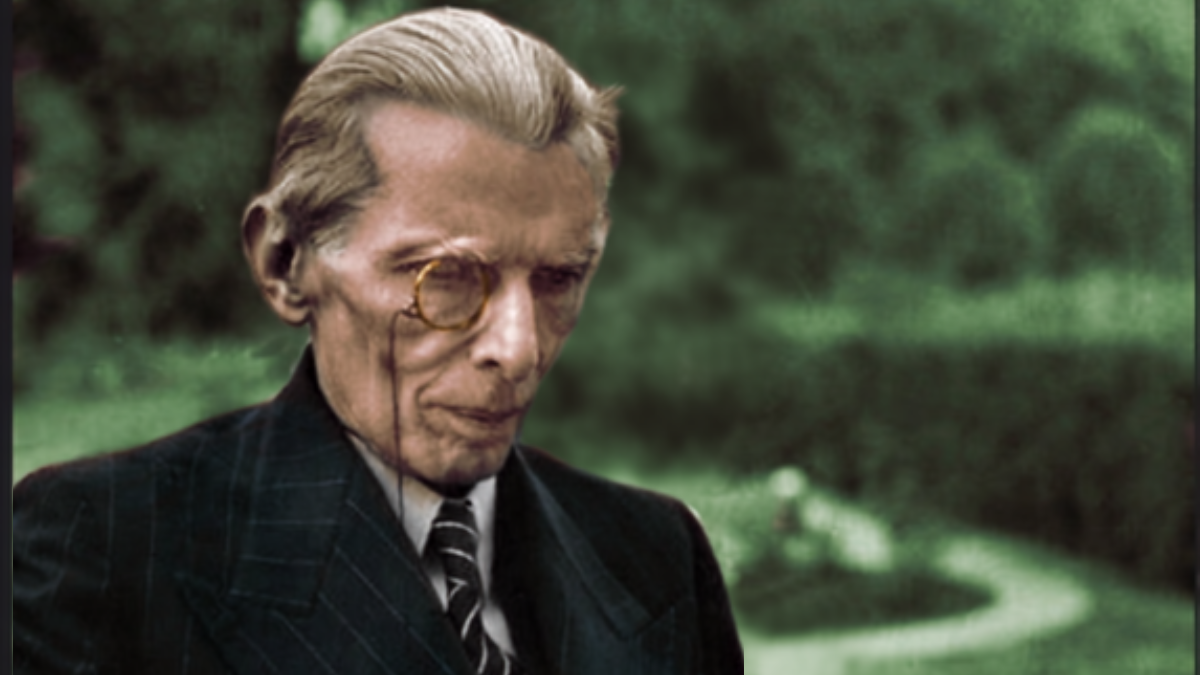
Pakistan was the focus of Jinnah’s projections and forward-looking statements, often called his vision. These were not political wishes but blueprints and warnings for the nation’s future. Jinnah avoided abstract predictions. His outlook appeared as stern cautions and core democratic principles. These were outlined across his speeches, notably the First Constituent Assembly address, August 11, 1947.
The Constitutional Pragmatist Era (1930s–1940s)
Jinnah led the All-India Muslim League and urged a separate homeland to protect Muslim political rights. Liaquat Ali Khan served as his ideological and operational counterpart. Liaquat shared Jinnah’s vision of a modern, democratic, and parliamentary Muslim-majority state rather than a clerical or theocratic one. Following independence, Liaquat Ali Khan became Pakistan’s first Prime Minister. He helped draft the Objectives Resolution, which balanced Islamic social justice with modern democratic governance. This echoed Jinnah’s dual emphasis: faith as a personal matter and the state as an equalizing civic institution.
The Post-Independence Modernist Era (1950s–1960s)
In the decades after Jinnah’s passing, politicians grappled with civil liberties and minority rights. They echoed Jinnah’s August 11 address. Huseyn Shaheed Suhrawardy, a premier jurist who would later become Prime Minister of Pakistan, aligned with Jinnah’s constitutional vision. He shared Jinnah’s commitment to democracy, parliamentary supremacy, and citizens’ legal safeguards. Suhrawardy advocated equal citizenship for minorities and opposed turning the state into an ideological monolith, echoing Jinnah’s pluralistic plan.
The core tenets of what Jinnah predicted, envisioned, and warned about for the future of Pakistan encompass several distinct dimensions:
The Rejection of Theocracy and the Rise of a Modern Democratic State
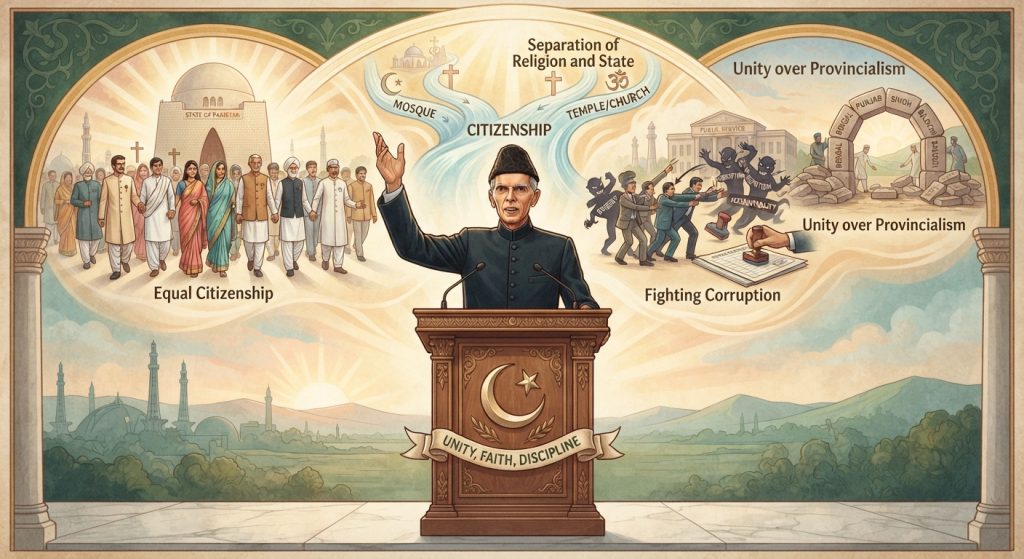
The Vision: Jinnah predicted that Pakistan would be a modern, democratic welfare state. He explicitly kept theocracy away from the government’s functioning. He did not envision a clerical state run by religious dogma, but rather a republic governed by the democratic will of its people, drawing inspiration from Islamic principles of social justice, equality, and fair play.
He understood that mixing hardline religious interpretation with state apparatus would foster division. He projected that for Pakistan to survive and progress globally, it had to separate personal religious faith from political citizenship.
Equal Citizenship and the Status of Minorities
The Vision: In his August 11, 1947 speech, Jinnah laid down a groundbreaking maxim for the new nation: “You may belong to any religion or caste or creed—that has nothing to do with the business of the State.” He predicted that political integration would eventually neutralize religious and communal divisions in the civic sphere.
The Forecast: He famously stated that in the course of time, “Hindus would cease to be Hindus and Muslims would cease to be Muslims, not in the religious sense, because that is the personal faith of everyone, but in the political sense as citizens of one State.” He foresaw a cohesive, singular national identity (“Pakistani”) that transcended sectarian or communal lines.
The Great Menace of Corruption, Bribery, and Nepotism
Furthermore, Jinnah possessed a deeply pragmatic and clinical eye regarding the administrative evils inherited from the British Raj. In his address to the Constituent Assembly, he singled out corruption, bribery, black-marketing, and nepotism as the greatest poisons threatening the nascent country.
The Prediction: He issued a grim warning that if the nation failed to eradicate these structural sins with an iron hand, the country would face immense internal decay. He called corruption “a poison” that the newly born government needed to put down ruthlessly, declaring it a monster that could hollow out the nation from within.
Economic Sovereignty and Social Justice
The Vision: While inaugurating the State Bank of Pakistan in July 1948, Jinnah emphasized that copying western capitalist models blindly would lead to the exploitation of the masses. He urged thinkers and economists to forge an economic framework based on true Islamic social justice—one that ensured the elimination of monopolies, protected the rights of labor, and bridged the gap between the rich and the poor.
The Indispensable Role of Women
The Vision: Jinnah repeatedly asserted that no nation could ever achieve greatness or progress if half of its population remained confined and sidelined. In multiple addresses (such as at Aligarh and Lahore), he predicted that the success of Pakistan heavily depended on women working alongside men in every sphere of national life, urging an end to restrictive customs that treated women like prisoners inside homes.
Summary
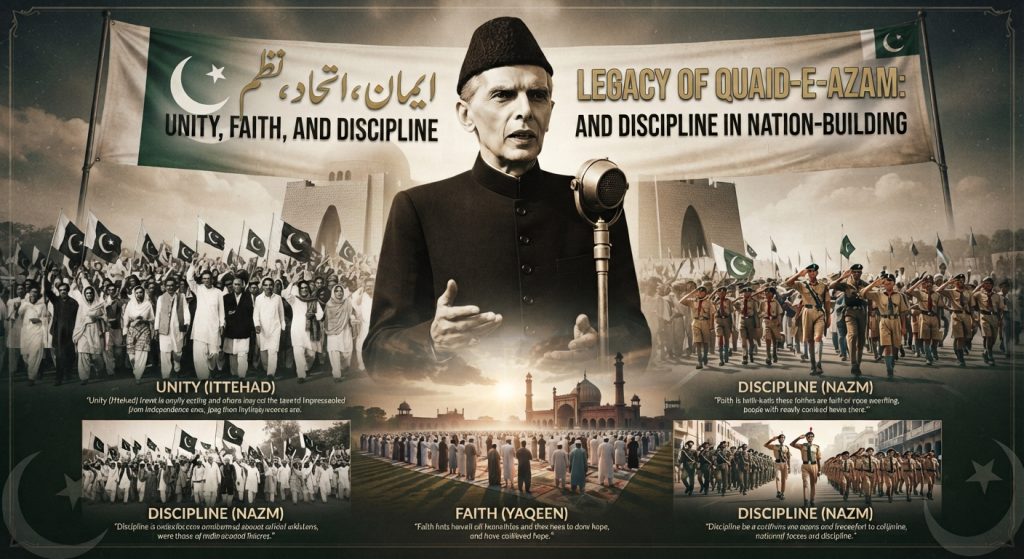
Jinnah’s outlook for Pakistan was anchored in Faith, Unity, and Discipline. Rather than seeing Pakistan merely as a geographic refuge for Muslims, he predicted it would become a progressive beacon of democracy, rule of law, and absolute equality. His speeches serve simultaneously as a proud blueprint for what the country could be and a prophetic checklist of the internal perils (corruption, sectarianism, provincialism, and bad governance) that continue to challenge the nation today.
Leave a thought 🤔 (0)
Be the first viewer to leave a thought!