As Pakistan navigates a complex landscape of shifting fuel prices, environmental pressures, and infrastructural limitations, its automotive market is undergoing a profound transformation. While the global conversation has heavily favored full electrification, the local adoption trend is carving a pragmatic path of its own. Hybrid Electric Vehicles (HEVs) and Plug-in Hybrid Electric Vehicles (PHEVs) have steadily emerged as the preferred bridge technology for Pakistani consumers.
1. The Realities of Infrastructure: Why Hybrids Make Sense
The primary catalyst for HEV and PHEV acceptance in Pakistan lies in the country’s current infrastructural landscape. Fully electric vehicles (BEVs) require a dense and reliable network of high-speed charging stations, alongside consistent grid stability.
Outside of major metropolitan hubs like Islamabad, Lahore, and Karachi, public charging infrastructure remains sparse. Furthermore, concerns regarding grid reliability and range anxiety discourage many potential buyers from taking a leap into pure electric ownership.
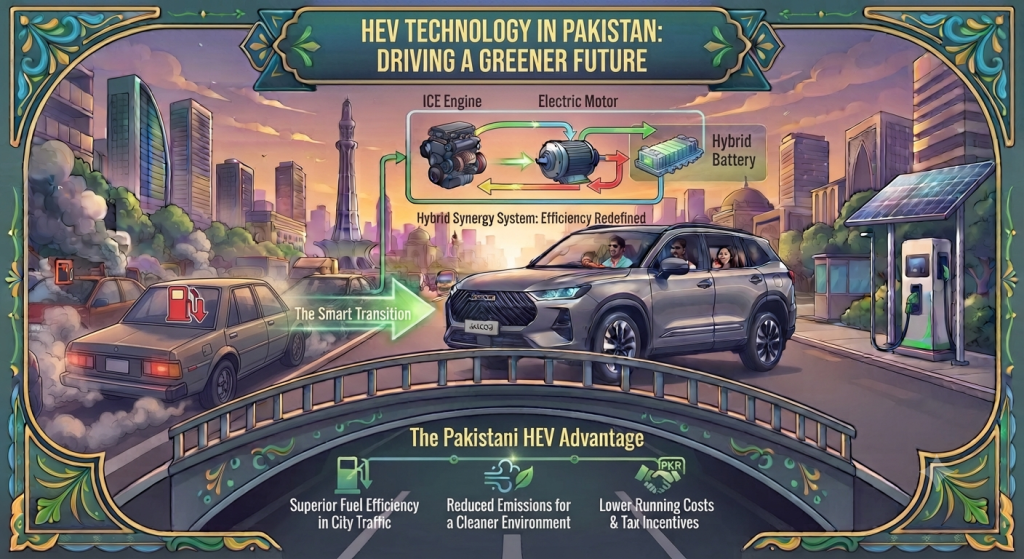
Hybrids and plug-in hybrids successfully bypass these hurdles. By combining an internal combustion engine with an electric motor, HEVs and PHEVs provide the fuel-saving advantages of electrification without requiring drivers to depend on public charging grids. Users can complete daily urban commutes on electric power or enhanced fuel efficiency while retaining the flexibility of traditional refueling for longer interstate journeys.
2. Economic Pressures and Running Costs
In a price-sensitive market like Pakistan, consumer behavior is heavily dictated by day-to-day operating economics. With persistent volatility and high rates for conventional petroleum, vehicle owners are hyper-focused on per-kilometer running costs.
Traditional petrol-powered cars, which often average lower mileage in congested city traffic, impose a heavy financial burden on daily commuters. HEVs and PHEVs offer a compelling counter-proposal. Their regenerative braking systems and optimized fuel consumption deliver substantial monetary savings in stop-and-go urban traffic, making them an attractive risk-managed investment for middle- and upper-middle-class households.
3. Industry Shifts and Local Assembly
The acceptance of hybrid technology has also been propelled by aggressive moves from both local assemblers and international manufacturers. Major players in Pakistan’s automotive sector—such as Indus Motor Company, Sazgar (Haval), and Hyundai Nishat—pioneered the market by introducing locally assembled hybrid SUVs and sedans.
More recently, the introduction of the New Energy Vehicle (NEV) policy framework and an influx of advanced Chinese automotive brands have widened consumer choices. Brands introducing plug-in hybrid options have seen enthusiastic early-market responses, logging thousands of bookings within short spans. This commercial traction demonstrates that buyers are actively seeking out electrified options that fit seamlessly into local road and weather conditions.
4. Resale Value and Consumer Trust
A unique nuance of the Pakistani automotive ecosystem is the heavy emphasis on resale value. Historically, early adopters of imported, niche electric vehicles faced steep depreciation curves and uncertainties regarding battery life and specialized maintenance.
In contrast, hybrid vehicles have steadily won the trust of local buyers. Because hybrid systems have a lower learning curve for local mechanics, feature established supply chains for parts, and boast predictable market behavior, they retain a stronger and more reliable resale value. For a risk-averse consumer base, hybrids represent a secure stepping stone toward a greener future.
The Road Ahead
Pakistan’s transition toward sustainable mobility is proving to be demand-driven rather than purely ideological. While full electric vehicles will undoubtedly grow as infrastructure expands over the long term, HEVs and PHEVs are firmly anchoring the present market. By addressing economic realities, fuel volatility, and infrastructure gaps, hybrid technology has successfully secured its place as the practical heartbeat of Pakistan’s automotive evolution.
Leave a thought 🤔 (0)
Be the first viewer to leave a thought!