
Few entertainment franchises hold as legendary and transformative a status as Capcom’s Street Fighter. For nearly four decades, this iconic fighting game series has fundamentally shaped the gaming landscape, revolutionized competitive esports, and birthed a vibrant global subculture. What began as a modest, experimental arcade cabinet in the late 1980s exploded into a cultural phenomenon, establishing the foundational rules for an entire genre. The immense cultural footprint of Street Fighter extended far beyond the glowing screens of dark arcades. In the mid-1990s, the franchise made the perilous leap to the silver screen, resulting in one of the most delightfully chaotic, campy, and polarizing live-action adaptations in cinematic history. Together, the games and their eccentric Hollywood counterpart weave a fascinating tale of digital triumph, cultural evolution, and lasting pop-culture infamy.
The Genesis of a Gaming Revolution The Humble Beginnings:
Street Fighter (1987) Released in 1987, the original Street Fighter arcade game introduced players worldwide to Ryu and Ken, two itinerant martial artists striving to prove their skills across international arenas. While the game was not an overnight blockbuster, it introduced revolutionary input mechanics that permanently changed arcade hardware. Arcade-goers utilized a combination of a directional joystick and six pressure-sensitive buttons mapped to light, medium, and heavy variations of punches and kicks. Crucially, the game pioneered secret special moves—such as the Hadoken, Shoryuken, and Tatsumaki Senpukyaku—which required precise, rhythmic joystick and button inputs. Mastering these inputs became a coveted badge of honor among arcade regulars, establishing the deep mechanical skill ceiling that would define future installments.
The Masterpiece: Street Fighter II (1991)
If the original game planted the seeds, Street Fighter II: The World Warrior (1991) created a raging forest fire. It is widely recognized as one of the most influential video games ever created, single-handedly resurrecting the stagnant global arcade industry in the early 1990s and setting off a worldwide fighting game boom. Diverse Roster: For the first time, players could select from a diverse, international cast of eight unique fighters, including Chun-Li (gaming’s first playable female warrior), Guile, Blanka, and Zangief, each boasting distinct fighting styles and character designs. The Combo System: Accidentally discovered by developers during testing, the combo system allowed players to chain individual attacks together seamlessly so opponents could not recover in time, injecting an unprecedented layer of strategic depth and execution mastery. Competitive Social Culture: Arcades transformed into vibrant community hubs. The thrill of tossing a coin onto a cabinet, challenging an anonymous stranger, and hearing the iconic “You Win!” Home consoles were unable to mimic the communal ambiance produced by announcer voices..
Expanding the Universe and the E-sports Boom
Capitalizing on its monumental success, Capcom released iterative updates—such as Champion Edition and Super Street Fighter II—before launching the daring Street Fighter III in 1997. Featuring gorgeous hand-drawn sprite animation and the innovative Parry system (which allowed players to tap forward to neutralize incoming attacks at the exact frame of impact), Street FighterIII: 3rd Strike became a cult classic cherished for its ultra-high skill ceiling.
The franchise reached another major milestone with Street Fighter IV (2008). By merging 3D character models with classic 2D plane mechanics, it revitalized the fighting game genre for the modern high-definition era and acted as the primary catalyst for the modern esports movement.
Evolution of Tournaments: Community gatherings evolved into massive, stadium-filling global spectacles like the Evolution Championship Series (Evo).
Historic Moments:
Iconic milestones, such as “Evo Moment #37” in 2004 where Daigo Umehara parried Justin Wong’s entire Super Art in 3rd Strike with single-frame precision, cemented the franchise’s legacy in digital sports history.
With Street Fighter 6, Capcom modernized the formula further by introducing accessible control schemes alongside traditional inputs, an immersive open-world single-player campaign called World Tour, and robust rollback netcode ensuring seamless global matchmaking. The secret to the series’ longevity is its timeless design philosophy: easy to learn, difficult to master.
The Silver Screen Adaptation (1994)
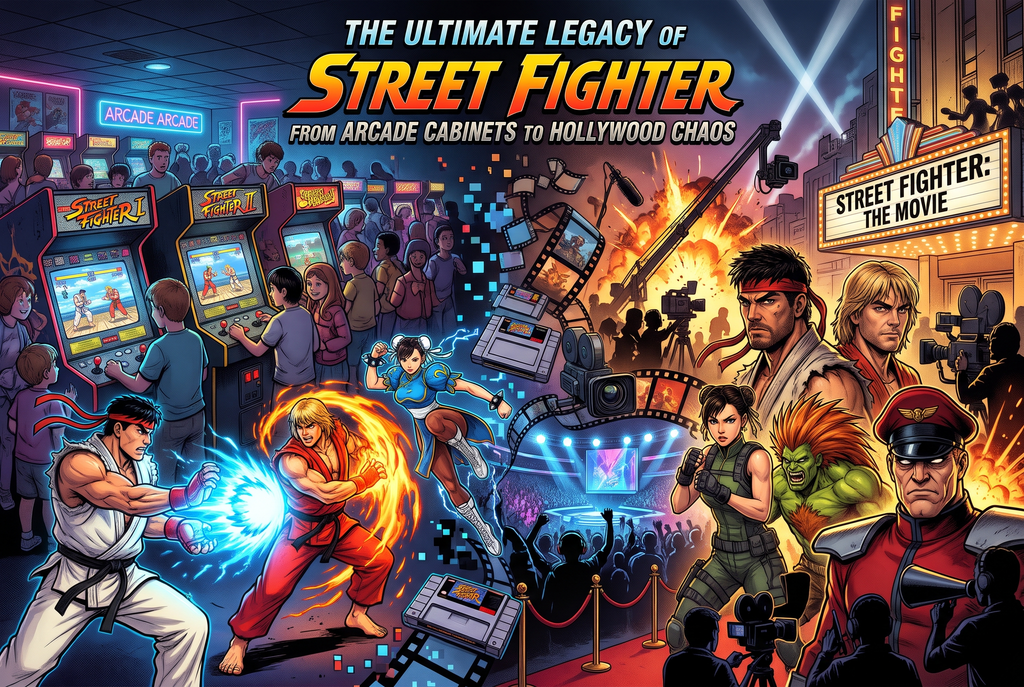
While the arcade cabinets were conquering the globe, Hollywood took notice. When studio executives decided to adapt Capcom’s martial arts franchise into a live-action blockbuster, fans expected a faithful recreation of fighters traveling the globe for tournament glory. Rather, what debuted in December 1994 was an odd, high-concept military science fiction action movie that totally altered the original material’s rules.. Directed by Steven E. de Souza, the live-action Street Fighter movie has since evolved from a critically panned adaptation into a beloved cult classic celebrated for its earnest cheese and quotable dialogue.
A Radical Departure from the Source Material
To the absolute bewilderment of arcade veterans, the film entirely bypassed the iconic world tournament framework. Rather than focusing on a bracket of fighters competing for glory, the narrative centers on a geopolitical conflict in the fictional, war-torn Southeast Asian nation of Shadaloo.
The villainous military dictator General M. Bison (played with magnetic enthusiasm by Raúl Juliá) takes dozens of Allied Nations relief workers hostage, demanding a massive multi-billion-dollar ransom. Enter Colonel William F. Guile—portrayed by action star Jean-Claude Van Damme—who leads an elite multinational strike force to infiltrate Bison’s fortress, rescue the captives, and dismantle his criminal empire.
While fan-favorite characters like Ryu, Ken, Chun-Li, Cammy, and Zangief all appear, their backstories were radically altered. Ryu and Ken were reframed as American con artists and arms-dealers-in-training, Chun-Li was transformed into an investigative television reporter seeking personal revenge, and Blanka was shockingly recast as Guile’s lost military buddy, Charlie, subjected to horrific genetic mutation.
Raúl Juliá’s Masterclass and Production Chaos
Despite its narrative shortcomings and loose relationship with the video games, the production is anchored by one unforgettable, transcendent performance. Raúl Juliá, battling severe illness during his final film project, delivered a tour-de-force as M. Bison. Refusing to treat the comic-book material with cynicism, Juliá played the megalomaniacal dictator with absolute Shakespearean gravitas and infectious joy. His delivery of iconic lines—most notably explaining to Chun-Li that the day Bison destroyed her village was the most important day of her life, but “for me, it was Tuesday”—cemented his status as a cinematic legend.
Behind the scenes, the production was famously tumultuous. Filmed under blistering heat in Thailand and Australia, the crew dealt with strict deadlines, script rewrites on the fly, and off-screen tensions involving its leading men. Yet, despite negative critical reviews upon release, the movie proved to be a box-office success, pulling in nearly $100 million worldwide against a $35 million budget.
Conclusion
Whether experiencing the tension of a tight tournament match on an arcade stick or quoting the delightfully campy lines of Jean-Claude Van Damme and Raúl Juliá, Street Fighter occupies a uniquely cherished space in pop culture history. It bridges the gap between competitive grit and sheer entertainment, proving that whether on the digital cabinet or the silver screen, the spirit of the fight never truly dies.
Leave a thought 🤔 (0)
Be the first viewer to leave a thought!