
The sudden illumination of a dashboard warning light triggers a universal physiological response: a tightening of the chest, a quick dart of the eyes, and the immediate onset of mental arithmetic. For generations, drivers have battled the visceral fear of being stranded on the shoulder of a desolate highway. In the modern automotive era, this dread has been branded with a specific, highly publicized title: range anxiety. It is widely cited as the ultimate psychological roadblock to mass electric vehicle adoption. Yet, treating this phenomenon as a modern, EV-exclusive problem ignores a century of driving history. Long before we worried about kilowatt-hours and charging networks, drivers were locked in a tense psychological battle with the glowing amber icon of a low fuel light. Range anxiety is not an invention of the electric age; it is a fundamental human reaction to managing finite resources on the move.
To understand the modern incarnation of this fear, we must look at the immense paradigm shift demanded by the electric vehicle. Internal combustion engine vehicles conditioned society to expect refueling stations on every major corner and a process that takes mere minutes to complete. Early EVs, hobbled by modest 70-to-100-mile limits, clashed violently with this ingrained expectation. Attempting a spontaneous weekend road trip in a first-generation electric car required meticulous, almost military-level logistical planning. Combine that with the harsh reality that extreme weather—particularly freezing temperatures—can dramatically slash battery efficiency, and the hesitation of early consumers was not just understandable, it was entirely rational.
However, the electric landscape of today is virtually unrecognizable from its infancy. The most significant shift has occurred within the battery architecture itself. Relentless advancements in lithium-ion chemistry and energy density have pushed the industry standard for new EVs to comfortably hover between 250 and 300 miles per charge, with flagship luxury models boasting ranges well over 400 miles. For the average commuter, who drives fewer than forty miles a day, this translates to a vehicle that could easily navigate an entire workweek without ever encountering a plug.
Physical range is only half of the EV equation; infrastructure and intelligence make up the rest. The global network of public charging stations is expanding at an exponential rate, moving from sparse urban novelties to ubiquitous highway staples. High-speed DC fast chargers can now pump a modern battery from a depleted state to 80% capacity in under half an hour—just enough time for a driver to stretch their legs and grab a coffee. Furthermore, modern EVs operate as highly sophisticated computers on wheels. Their intelligent navigation systems actively monitor battery health, elevation changes, ambient weather conditions, and driving speed in real-time, routing drivers seamlessly through available charging hubs and completely eliminating the guesswork that once fueled a driver’s deepest anxieties.
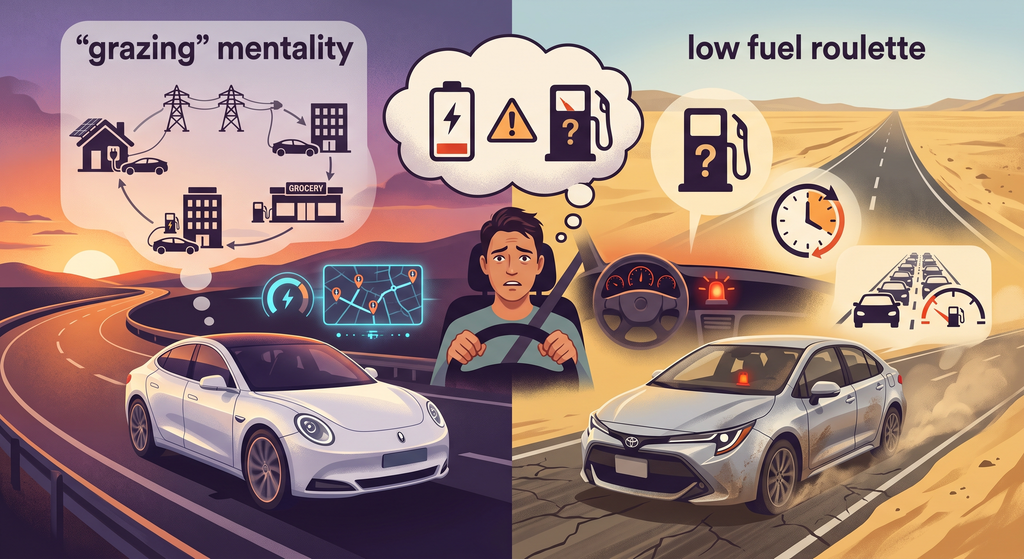
Ultimately, overcoming EV range anxiety demands a psychological unlearning of the traditional gas station model. True electric vehicle ownership introduces a **”grazing” mentality**. Instead of driving until the vehicle is running on fumes and making a dedicated trip to refuel, EV drivers plug in opportunistically—overnight at home, during the day at the office, or while parked at a grocery store. When your car leaves the driveway with a full battery every single morning, the daily threat of range anxiety quickly evaporates into obscurity.
Yet, as the EV industry works tirelessly to banish this fear, it is vital to recognize that petrol drivers have been suffering from their own brand of range anxiety since the invention of the Model T. The most common cause of range anxiety in combustion vehicles is deeply rooted in human behavior—specifically, our tendency to procrastinate. Because petrol drivers cannot magically wake up to a full tank every morning, refueling remains an active, often inconvenient errand. It requires an intentional detour, waiting in line, and braving the elements at a pump. Because it is a chore, drivers routinely push their luck, playing a dangerous game of fuel roulette. The spike in adrenaline when the needle dips below the red line while stuck in the fast lane of an interstate is identical to the panic of an EV driver hunting for a supercharger.
Furthermore, situational range anxiety is a deeply ingrained part of the petrol experience. While urban centers are densely saturated with fueling options, rural and cross-country travel expose the vulnerabilities of the combustion engine. Encountering a weathered sign warning, “Next Gas 100 Miles,” across a desolate stretch of desert or a winding mountainous region triggers an immediate, stressful calculation of fuel economy. In these unforgiving environments, a single wrong turn, a missed exit, or pulling into a rural station only to find the pumps out of order can instantly transform a scenic road trip into a high-stakes survival scenario.
Unpredictable driving conditions also ruthlessly expose the limits of the petrol tank. Fuel consumption is never measured strictly by distance; it is heavily dictated by time and environment. Being trapped in gridlocked traffic or stranded on a highway during a severe winter whiteout with only a quarter tank of gas is a universally terrifying experience. As the engine idles just to keep the cabin heater running, the driver is forced to watch the fuel gauge slowly drop without moving a single inch. The creeping realization that the car might run dry before the traffic clears is the absolute definition of range anxiety, proving that a tank of liquid fuel is just as vulnerable to the elements as a lithium-ion battery.
Economic realities play an equally massive, yet often silent, role in petrol-induced anxiety. For a vast number of drivers, filling a tank to the absolute brim is a rare luxury. Fluctuating global fuel prices and tight personal budgets routinely dictate buying gas in small, ten-dollar increments, leaving the vehicle perpetually hovering near the bottom of the gauge. This creates a chronic, low-grade range anxiety—a daily, exhausting calculation of whether the remaining fumes are enough to survive the commute to work and back.
The transition away from fossil fuels has not created a new automotive phobia; it has merely attached a modern label to a timeless feeling. The fear of the unknown, the dread of the empty tank, and the instinctual drive to protect our momentum unite all drivers on the road. Whether you are anxiously hunting for an available fast-charger in an electric sedan or praying your sputtering engine makes it to the next petrol pump, the underlying human experience remains exactly the same. We are all just trying to make it home before the energy runs out.
Leave a thought 🤔 (0)
Be the first viewer to leave a thought!